by Ashley Johnson
July 29 – 31, 2011
Meaford, Ontario
I have wanted to attend the Electric Eclectics Festival since coming to Canada in 2005 and finally got an opportunity. Gary Silverberg of Art Condos, who is one of the EE sponsors, rolled out a press limo for the occasion, thoughtfully providing fluids and snacks. So, on a sweltering Saturday, we tumbled out onto a hillside descending to a meadow at the ‘Funny Farm’ in Meaford.
Gordon Monahan was on hand to greet and orientate us. He is one of the organizers and is also an accomplished musician and sound installation artist. An impressive retrospective of his work has just been seen at several public galleries in Ontario.
The main stage acts were scheduled for late afternoon so I went exploring, hoping for respite from the sun. People camp for the weekend and the hillside was dotted with colourful tents. They bring their own libations too, which was an unfortunate omission on my part. Luckily food and other cold drinks are available.
This festival was not just about sound and included a number of interesting art installations, some malevolent robots, 3-D video and DJ-ing in the tent. There was a lot to see and do, including visiting the nearby beach for swimming.
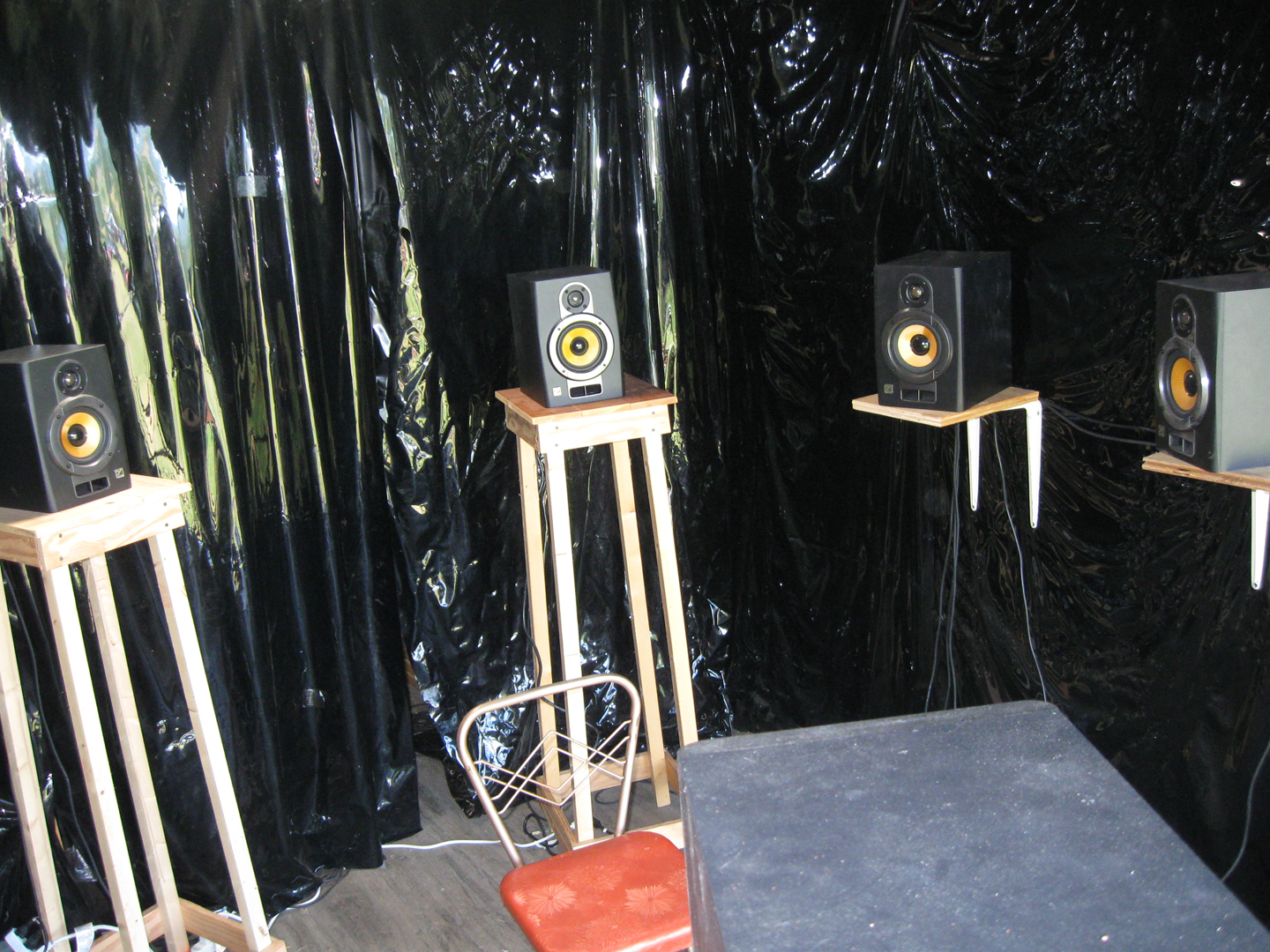 TONSPUR by Georg Weckwerth and Peter Szely. Photo: Ashley Johnson
The first acoustic installation I encountered was Austrian Astrid Seme’s entrancing ‘Urbirds Singing the Sonata’ (TONSPUR 41). TONSPUR is a permanent sound installation series curated by Georg Weckwerth and Peter Szely in Berlin, Vienna and Prague. Seme’s piece consists of a circle of speakers around a swivel chair. Each speaker emits a cycle of different bird sounds that swirl around the listener.
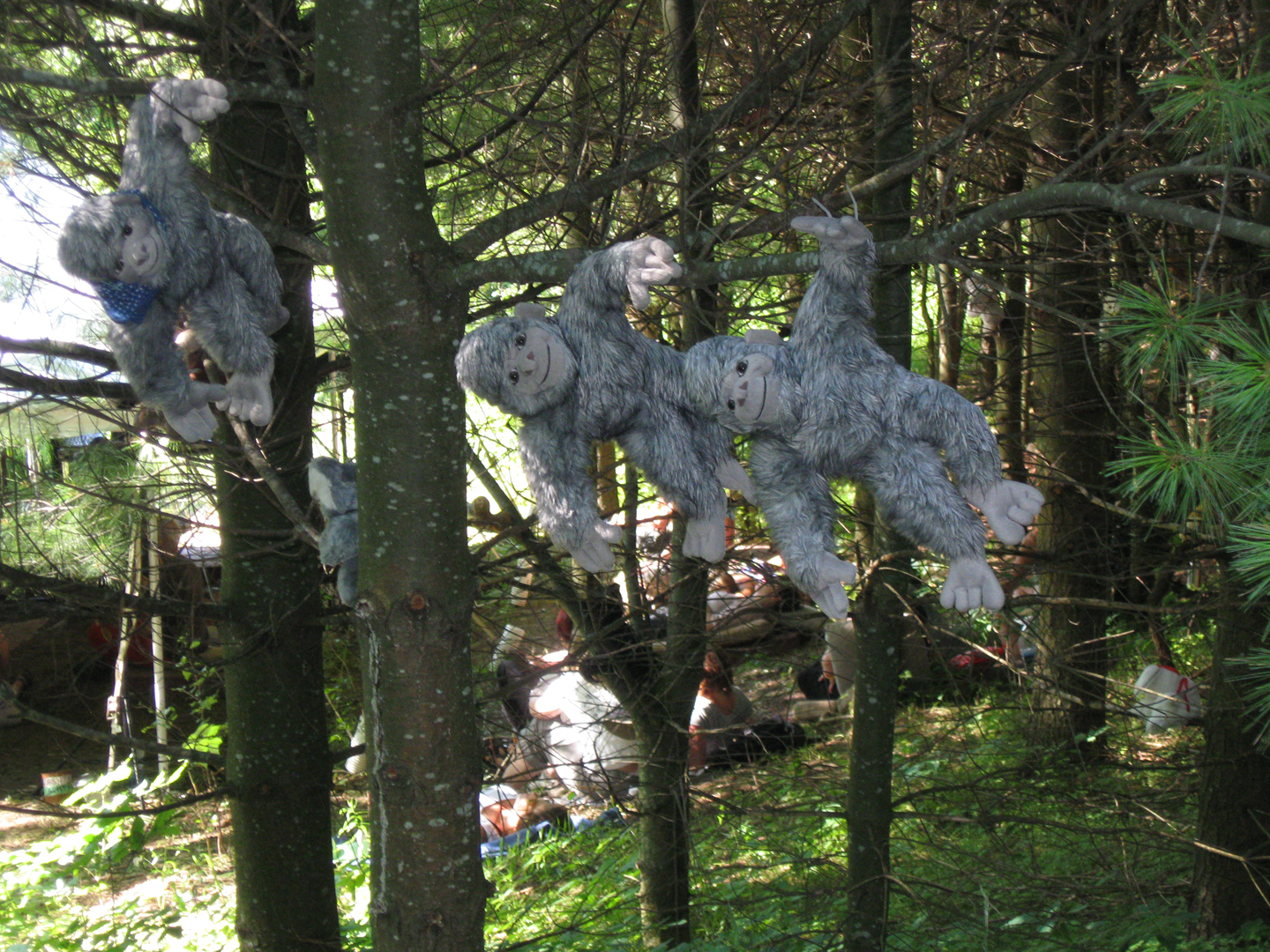 Stuffed monkeys. Photo: Ashley Johnson
Then, I staggered off down the hill into the forest valley where the DJ tent was situated. Stuffed animal toys lashed to branches are an odd touch. Sunda Duo Andrew Timar and Bill Parsons were playing soothing acoustic Indonesian instruments in the Gamelan tradition featuring a 20 string plucked zither, bamboo flutes, kacapi and traveling guitar. This tradition requires paired instruments to be tuned to one another slightly differently so that interference beats are created, causing a buzzing sound quite different to Western tuning.
Next I visited Hilary Martin’s tent installation – Public Displays of Affection, where several wooden robots waited on a paper surface for the unwary. Hilary handed me some lipstick with the injunction to apply it. Hilariously I put it on my own lips not realizing that it was intended for the wooden lips of the robots! Duly applied and set, the robots respond to kissing noises that trigger a smack on the page.
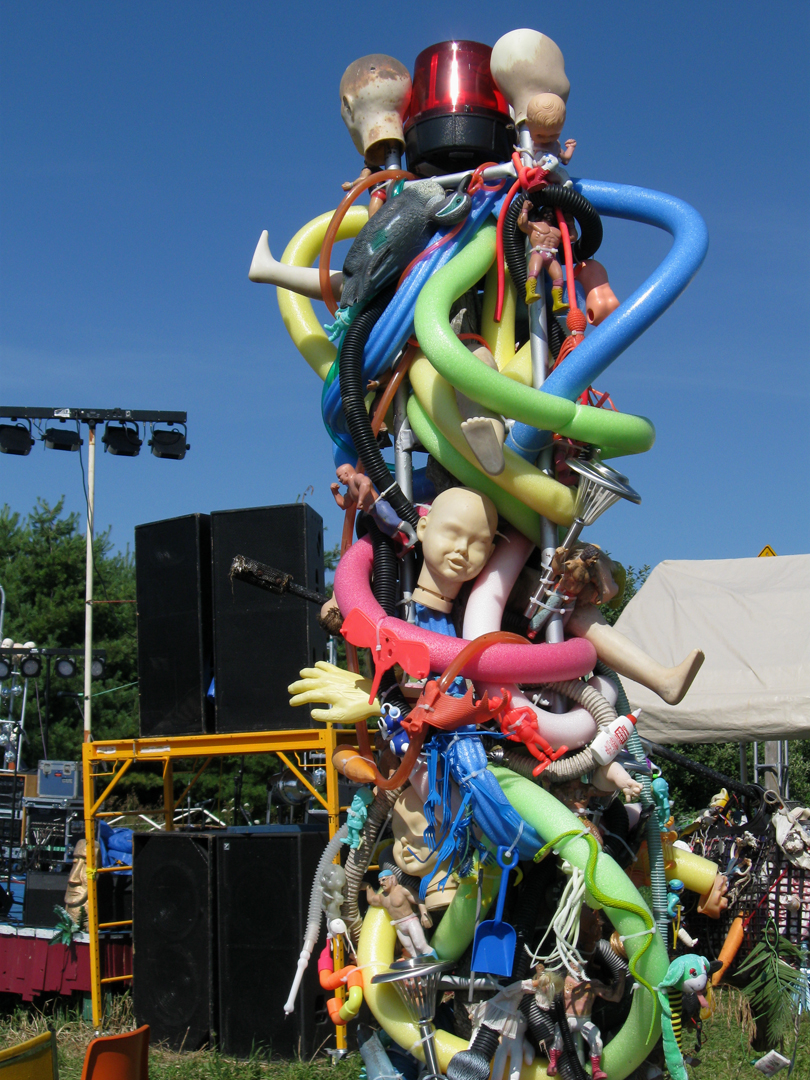 Toy tower. Photo: Ashley Johnson
Gathering remaining dignity, I set off for the main stage and the first act. The stage itself is eccentric with pillars of colourful toys and leaping stags. Audiolodge led the way with an interesting set. Kevin Curtis-Norcross, Troy David Ouellette and Paul Walde interact with speakers using a variety of implements like violin bows on stretched wire. Lesley Flanigan (New York) also exploited the capacity of speakers and microphones, using feedback and amplification. Sitting, surrounded by prepared speakers, she vocalizes and gets the sound swirling around her, reverberating and establishing a chorus. It was hauntingly beautiful.
The heat on stage was intense for the performers as Torontonian Isla Craig and her guitarist Colin Fisher melded a more folk/trancelike music. The vocals and guitar had a lot of echo and reverb. Her voice was mesmerizing in its melodic flux.
With the sun’s dying rays, Idiot Glee aka James Friley of Lexington, Kentucky played a set. He layers recordings of his voice adding organs and bass lines to create rich choral textures. The songs are reinterpretations of pop songs like “That’s All for Everyone” (Fleetwood Mac) that slowly and hypnotically unwind into the air.
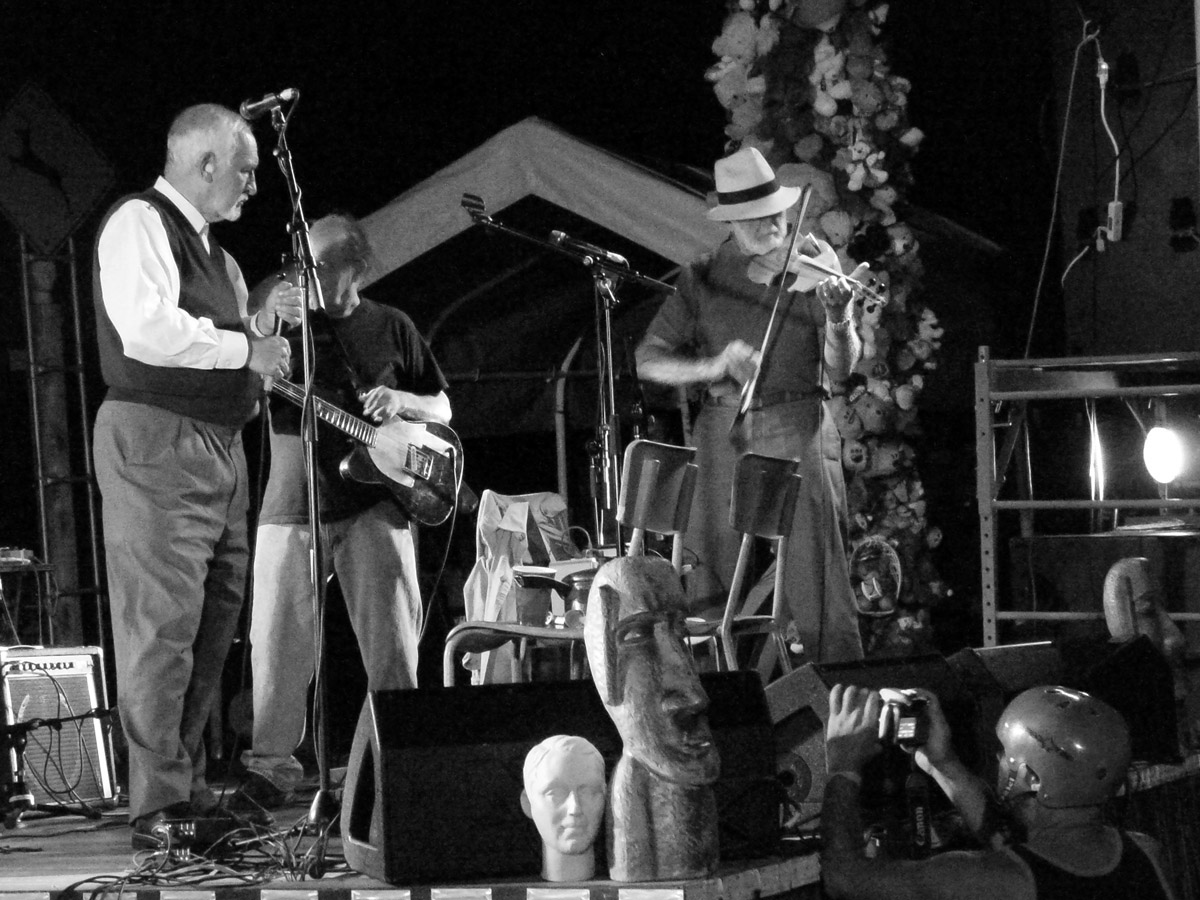 Nihilism Spasm Band. Photo: David Hlynsky
Later, the Nihilist Spasm Band from London, Ontario with guest Alexander Hacke (Berlin) smashed into the night. Formed in 1965, they have international repute as one of the first noise bands. Vocalist Bill Exley delivers a manifesto of political discontent about ownership or meat eating before the band launches into full-bodied improvisation using odd instruments like electric kazoos and pots alongside altered or built guitars and drums. They swept the night before them like a wave.
Various other interesting acts punctured the evening but unfortunately it was time to catch my taxi back to Toronto. Winding my way back I was confronted by the malevolent robots of Apetechnology, a former collaborator with Survival Research Laboratories. One of these remote controlled contraptions had a wild, swinging drum that flashed light and sound at knee height. The other had steel teeth and rolling white eyes. It came up to say “I seeee you” in a mechanical voice.
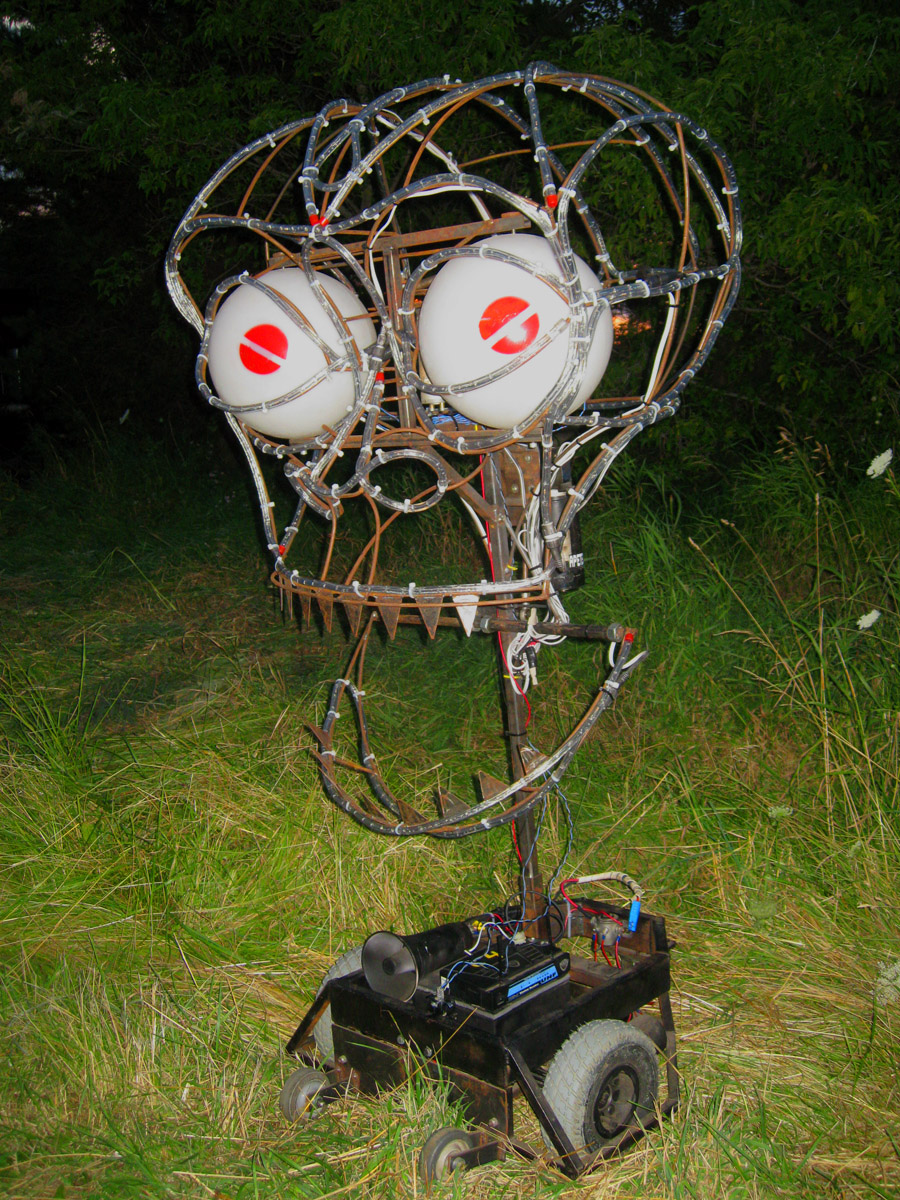 Apetechnology. Photo: David Hlynsky
I took one final look into a trailer showing Willy Le Maitre’s 3-D video Outlook Expressed. This seemed like a primordial event as seeds transmogrified into other forms while seeming to be situated just in front of the screen. Sky and earth had traded positions.
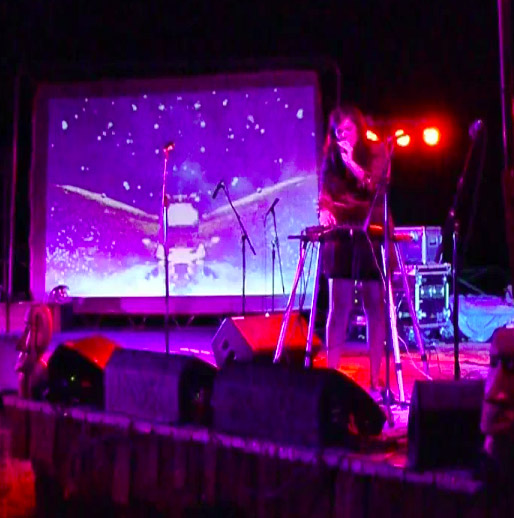 Julianna Barwick. Photo: David Hlynsky
On the whole this festival is thoroughly entertaining and educational. I noticed that many of the audience are regulars and come geared for a party with lasers and flashing lights in their hair. Next year I’ll be back to camp.
For links to the artist’s sites to listen to their music and further information on Electric Eclectics see http://www.electric-eclectics.com .