Category: BRIEFS

  • Brothers of the Weird

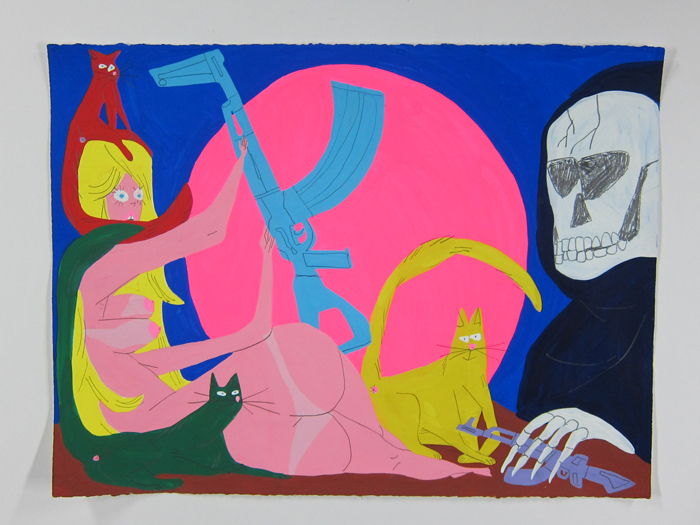
    Todd James, Vanity Nemesis  2011, gouache and graphite on paper, 30″ x 22.5″

    November 25, 2011 – January 22, 2012
    COOPER COLE GALLERY

    The opening of Cooper Cole Gallery’s new exhibition, Brothers of the Weird, also marks the relaunch of the former Show & Tell Gallery under a new name. Brothers is a group show featuring the work of five artists—Todd James, Devin Flynn, Ian Flynn, Billy Grant, and Joe Grillo. Though most of these artists have never shown work together before, their vivid and uproarious visual language makes the grouping feel like a conversation among friends, which it is in a way—two of the artists are brothers, while Grant and Grillo are both members of the New York–based Dearraindrop Collective.

    The work is sharply psychedelic, graphic, and lushly-coloured. Todd James’ “Chloe” paintings are the stars of the show—with their still life-inspired composition, exuberant palette, and blonde bombshell in the foreground. James’ work takes cues from art history heavyweights like Willem de Kooning and Franz Kline, yet also shows signs of influence from his fellow Americans Philip Guston and Roy Lichtenstein.

    Dearraindrop members Grant and Grillo’s work also satisfies a need for colour and bounce. The group’s graphic design background is evident in the paintings which feel like Saturday morning cartoons reimagined by graffiti artists. The Flynn’s work is quieter by comparison. You can still hear the message—you just have to listen more closely.

    Daniel St. Germaine
  • Nicholas Stedman: Tribot

    November 2–13, 2011
    GALLERY 1313 Main and Process Gallery


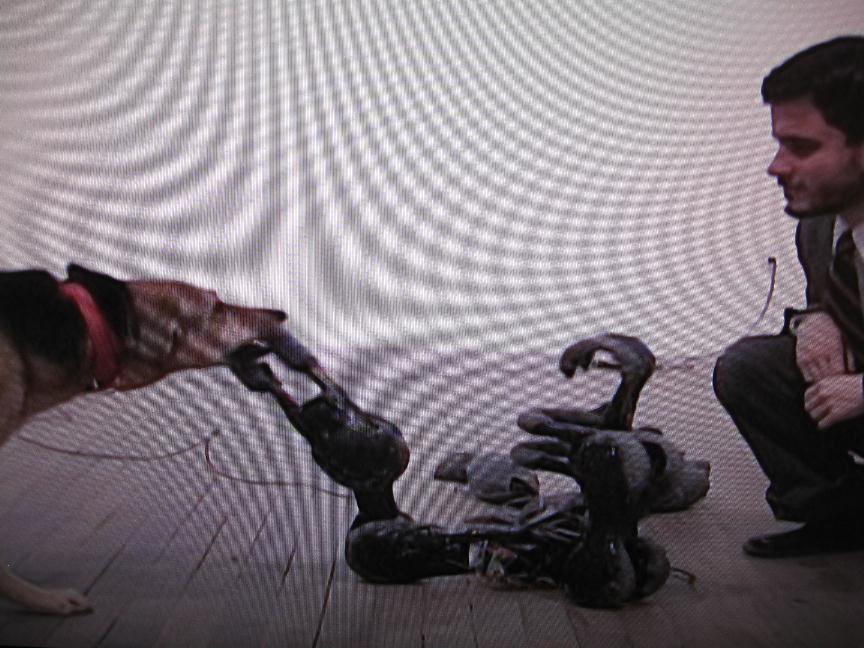
    Nicholas Stedman’s experimental project, Tribot, can be found in the current exhibition at Parkdale’s artist-run centre, Gallery 1313.

    The Message participates in Toronto’s marking of Marshall Mcluhan’s centennial, featuring artworks which commemorate and reflect on the constant impact of his theoretical legacies. Tribot, a continuation of Stedman’s ongoing effort to create artificial life in the form of companions, is comprised of a dog, a man, and a robot, all confined in one white-walled room. The interactions of the three are recorded, and the exhibition displays this video documentation alongside the now inactive robot. With a focus on behavioural rather than visual elements, Stedman’s robot is meant to instigate social relations, in this case with the dog, to see how it (or someone) will react to artificial life as opposed to interactions with that which is “real.” Stedman’s work comes across as a playful experiment, with the unruly behaviour of the dog, and the amusement of Stedman as mediator, provoking laughter. Yet Tribot holds great intrigue, as it underlines the increasingly present tensions in our contemporary framework between that which is alive and that which is lifelike.

    Miriam Arbus

  • Susan Hiller: The Last Silent Movie

    PREFIX INSTITUTE OF CONTEMPORARY ART
    September 22–November 26, 2011

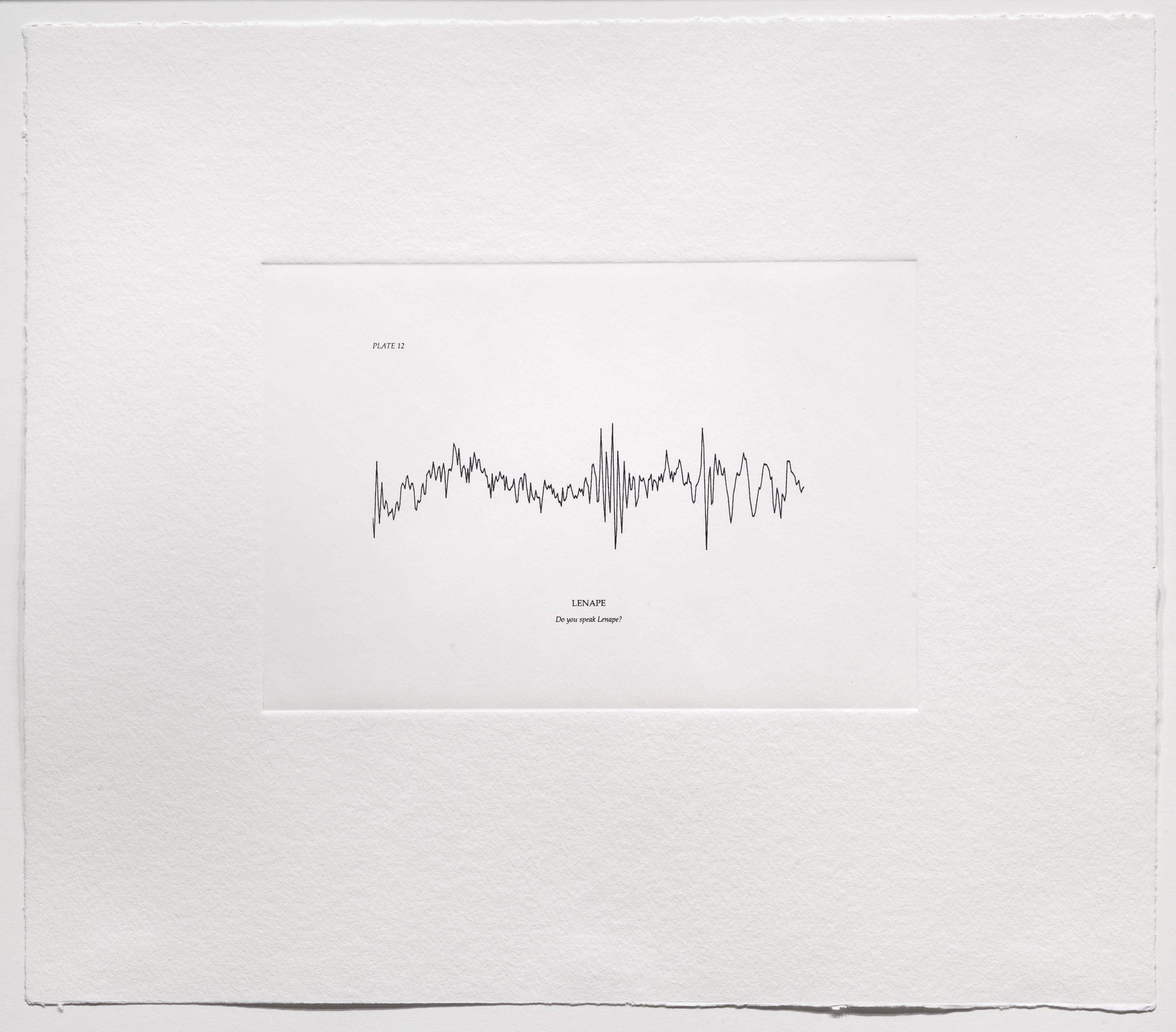
    Mysticism and intrigue are both key themes in Susan Hiller’s “The Last Silent Movie.”  This video projection and collection of etchings is based upon the recordings of some of the last remaining speakers of twenty-five endangered or extinct languages and plays a dual role as both a memento and a candid protest to the tragic loss of heritage and culture.

    Often including song, poetry and story-telling, these recordings are relayed in an informal setting evocative of a traditional movie house, with the translations being projected as subtitles on a fairly large wall. The recordings include Khulkhasi, Yao Kimmien, Jiwali, Ubykh and Welsh Romany.

    Common motifs of these recordings appear to be the loss of heritage, fear and concealment. Frequent anecdotes and humorous tales make this illuminating experience very heartwarming, not to mention entertaining.Susan Hiller, The Last Silent Movie, 2007. Lenape, 46.25 x 51.5 cm. Courtesy the British Council & Timothy Taylor Gallery (London) / Photo Credit: Toni Hafkenscheid
    Accompanying this auditory presentation is a series of etchings, depicting artist-selected phrases from the recordings, fed into an oscilloscope and put on to paper. All the twenty-four etchings present a single line that rises and falls depending on the unique elements of the specific utterance. While the audio recordings provide a tremendous auditory experience, the etchings are a visual equivalent.

    Haafiz Kalim

  • Gregory Scott

    Gregory Scott
    Art Toronto, 2011
    October 28 – 31, 2011

    This year’s Toronto’s International Art Fair was a great success. Filled with works of different media, one was constantly turning his head in order not to miss out on anything. My favorite pieces for this year’s art fair are Gregory Scott’s mixed media works at the Catherine Edelman Gallery: Dialogue, 2011; Construct, 2011; Attemptuous, 2008; Thanks for the Scribbles, 2011.

    Dialogue, 2011. from Catherine Edelman Gallery, Chicago on Vimeo.

    Often using himself as the model, Scott explores the idea of making still images move. His method is incorporating photography, painting, and video together in a seamless manner so that none of the mediums are distinguishable from another. His narrative works break the boundaries between the static and time-based media of representation, expanding the discourse between the media. These works also deal with the concept of pictorial illusionism, challenging the viewer’s perception of photographic truth. In a way, they could be seen as modern versions of the traditional trompe l’oeil illusionist paintings of the past.

    Humorous, witty, and a commentary on the art world, Scott’s works generate a viewing experience that fools the eye and plays with the mind.

    Michelle Lun

  • Art Toronto, 2011 / Angelo Musco

    October 28–31, 2011
    METRO TORONTO CONVENTION CENTRE

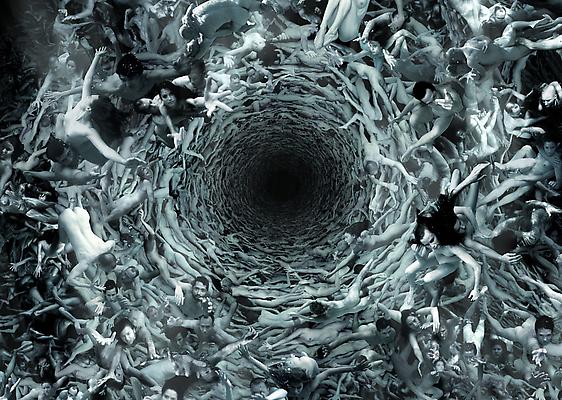
    At Carrie Secrist Gallery’s booth, there is a large photograph by Angelo Musco showing hundreds of human bodies like a spider’s web.

    I first saw this 12 x 48–foot photographic installation called Tehom in Chicago in May, 2010, at the Carrie Secrist Gallery, where it covered the walls from floor to ceiling. Musco used more than 100,000 human figures to create his fantastic, monumental, baroque vision. Tehom is first mentioned in the bible in Genesis and refers to the primordial waters of creation. It is believed that humans lived in these waters time and time again. Looking at the people in Musco’s images, I had a hard time understanding the message of their gestures. It took me by surprise when I realized that they were actually inviting me to join in. The figures seemed happy. I looked at them with a combination of uneasiness and amusement. I feel the same now seeing his photo of a human web. The image is surreal but, at the same time, very realistic, since it is a photographic montage of circles of people.

    Mr. Musco said that in his next series people come out of the water and will engage in Earthly visions.

    Emese Krunák-Hajagos

  • ¡Patria o Libertad! Johanna Reich: ‘Monument’

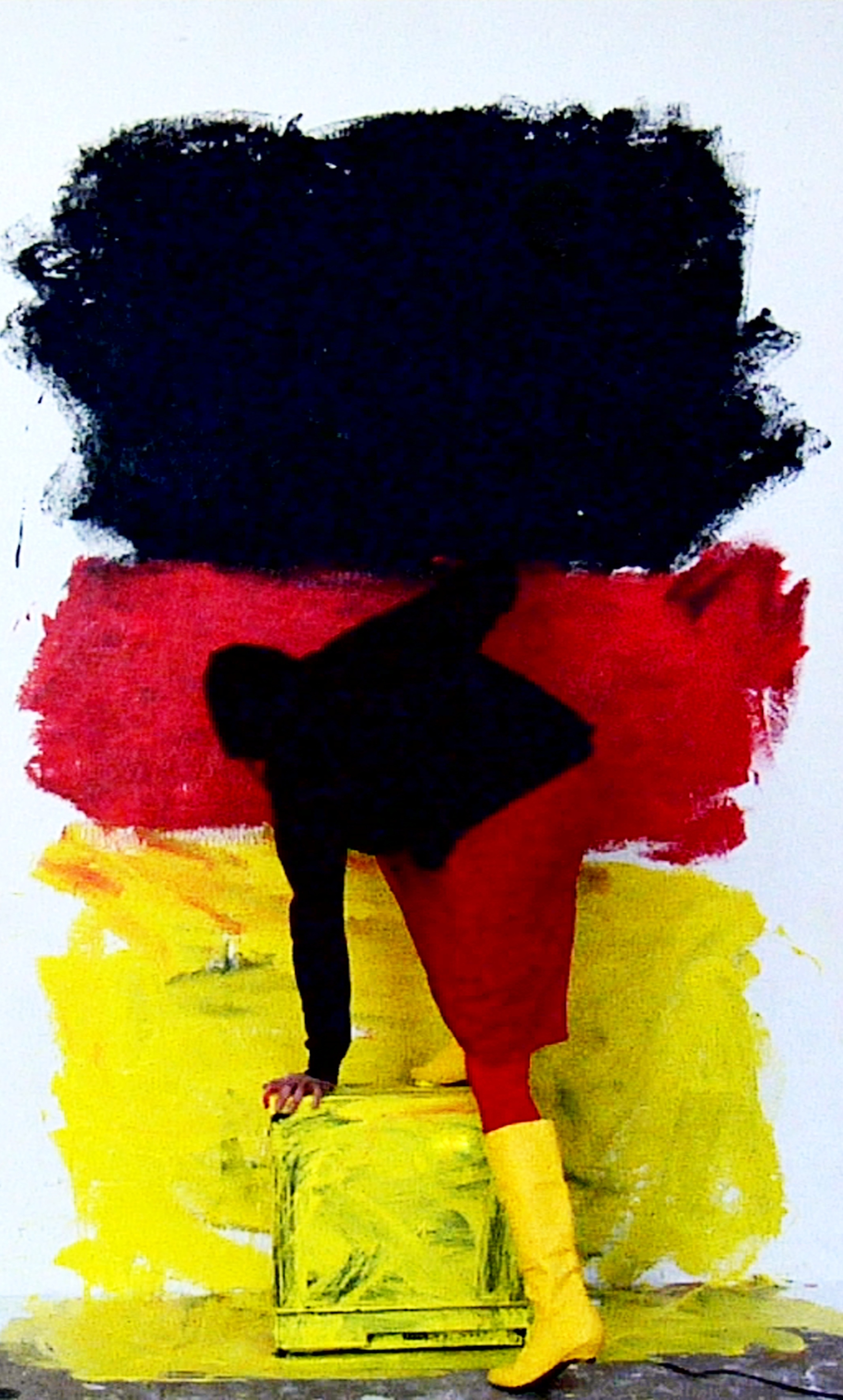
    Johanna Reich, ‘Monument,’ 2009, video projection, 5:45. Courtesy of the artist

    September 9–October 30, 2011
    MUSEUM OF CONTEMPORARY CANADIAN ART

    Nationality has many faces in the show at Mocca. It can be tormenting, paralyzing, aggressive; it can overtake your life, turn you into a killer, make you a victim, or it can make you proud and happy.
    In Johanna Reich’s video installation, a young woman paints a wall with a huge brush, applying generous amounts of paint from large containers. She puts many layers of paint on it really quickly. She starts the painting at the bottom with yellow then moves up and applies a big area of red. Now the painting is getting larger and she has to reach up, even standing on a stool to continue. The next wide stripe she paints is black.
    That is the moment we recognize that the colors she is painting are of the German flag. We also start to grasp that her dress might not be as weird as it seems. There might be a reason she is wearing yellow plastic boots, red pants and a black sweater.
    She finishes her work as suddenly, as fast, as she started. She steps back, looks at it for a moment and then steps up on the stool and disappears into the painting.

    Watching the ending of this video, I couldn’t help envying anyone who was born into a democratic country, like Reich, who grew up enjoying freedom and the choice to blend in.

    Emese Krunák-Hajagos

  • ¡Patria o Libertad! ANTUAN:‘Left or Right’

    ANTUAN, ‘Left or Right’, 2010 Video, 5:00. Courtesy the artist
     
    September 9 – October 30, 2011
    MUSEUM OF CONTEMPORARY CANADIAN ART

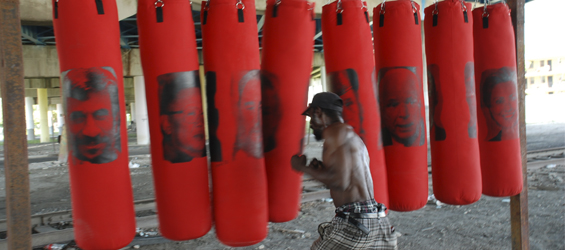
    Eight red punching bags are hanging from metal hooks, each wearing the portrait of a politician. The background suggests a poor neighbourhood where working class people live. The artist ANTUAN is from Cuba where most buildings are badly maintained. So it could be anywhere, in Havana, in any town or in the countryside. The colours of the bags refer to communism, the red flag of the Soviet Union, and the countries it dominated, Cuba being the last one standing.

    The politicians painted on the bags come from the left and the right (as the title of the video hints) representing the people’s options. A man comes into this arena and starts to punch the faces on the bags. He punches and punches them harder and harder until sweat is running down his face and his knuckles become red.

    Coming from a communist country I know this feeling of anger from experience. I tried the punching too. But still my question remains: after all this fighting, who is getting hurt?
    Emese Krunák-Hajagos


  • General Idea: Mondo Cane Kama Sutra

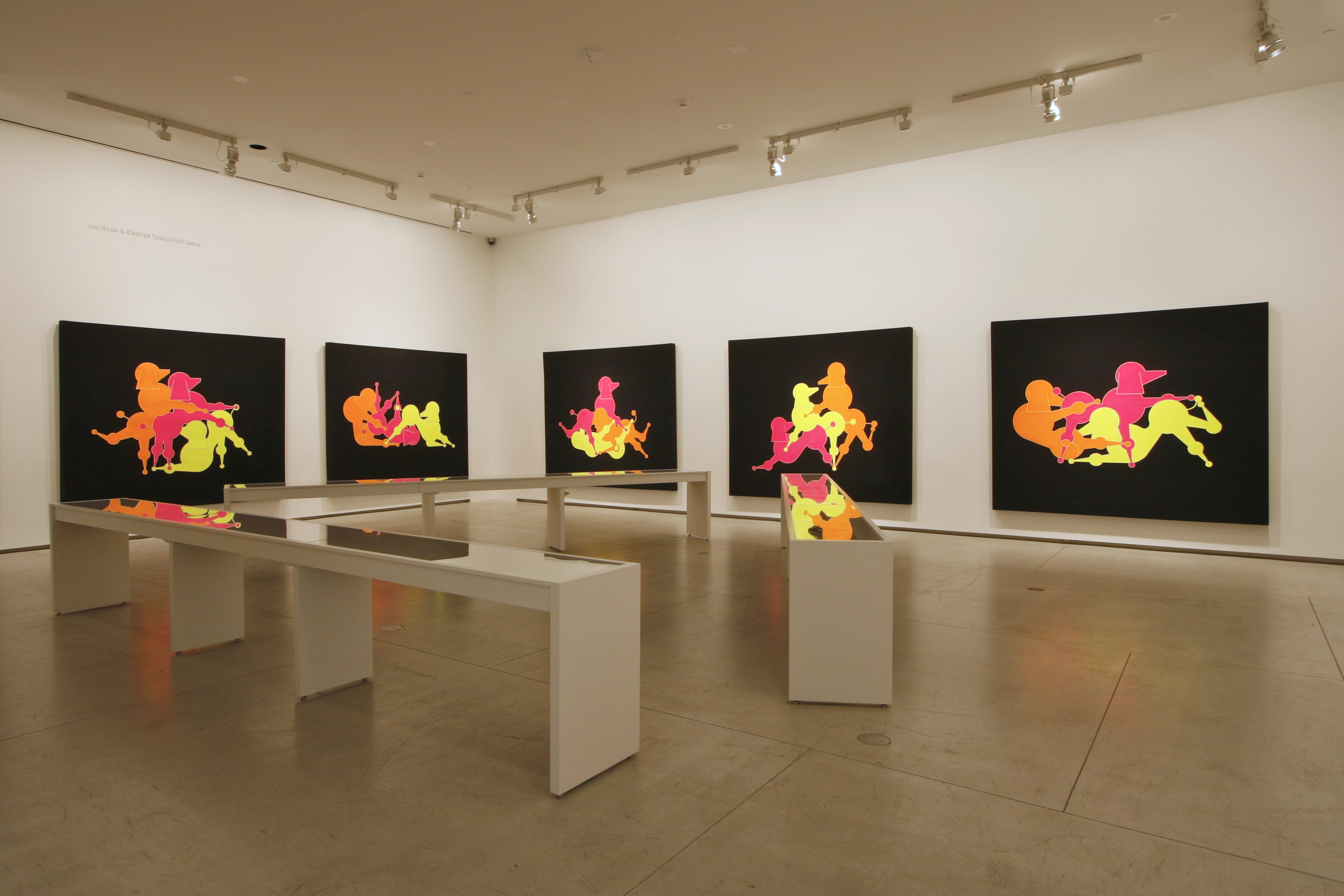
    Mondo Cane Kama Sutra (installation view) 1984, acrylic on canvas. 10 canvases, 245 x 305 cm each. Image courtesy the Estate of General Idea; © Pierre Antoine, Musée d’art moderne de la Ville de Paris / ARC, 2011.

    ART GALLERY OF ONTARIO
    July 30, 2011–January 1, 2012

    “Haute Culture” is a preeminent opus of the collective General Idea that features approximately 300 pieces of artwork, consisting of paintings, magazines, sculptures and video.  Being an extremely unconventional trio, General Idea’s artwork reflects this by the materials and sometimes colours used which often vary from loud neon shades to whites and blues all intricately corresponding to various themes presented.

    One piece that highly stands out, however, is the Mondo Cane Kama Sutra, 1984. This features a running theme of three poodles each on ten panels, carrying out various sexual positions. What makes this piece so remarkable is the neon colour of the poodles presented on the canvases and the scale of the panels, creating a gigantic eye-capturing façade. The fact that this artwork brings out a taboo in human society, homosexuality, makes the artwork all the more appealing in light of its daring attempt to depict an often misunderstood subject. The lines used in this piece are undoubtedly straight and perhaps unyielding and this may be a subtle allusion to the rigidness and ‘straightness’ of society in the 1980’s  juxtaposing the general theme of the artwork.

    Haafiz Karim

  • Kent Monkman: The Art Game

    KENT MONKMAN. COURTESY OF THE ARTIST

    October 28 -31, 2011
    Toronto International Art Fair
    Metro Toronto Convention Centre

    The centrepiece of Art Toronto 2011 is the fair’s flagship work by Toronto-based Cree artist Kent Monkman, curated by Steven Loft. The Art Game is a life-size maze, constructed from booth walls identical to the Art Fair itself, which will lead the audience through an art world “funhouse”. The meandering corridors are made more confusing with the use of double-sided mirrors, trick windows, and fake doors, creating a feeling of disorientation and forcing the audience into a challenging experience of perceptual distortion and multiple choice. Dispersed throughout the maze are four “dioramas”, each presenting one of the four key players in the Art Game: artist, curator/museum director, gallerist, and collector.

    This monumental installation draws on many of the same themes that reoccur throughout Monkman’s work, articulating them with trademark wit and whimsy. Monkman’s film, painting, and performance practices consistently deal with notions of subjectivity, history, sexual identity, and colonial legacies. In The Art Game, Monkman zeroes in on the business of art as the subject for his wryly humours treatment, presenting the audience with something that is at once a critique, an homage, a condemnation, and a fantasy.

    by Daniel St. Germaine

  • Richard Barnes: Animal Logic

    Academy Animals 2004 from Animal Logic-Ed. Of 5 + 2 AP chromogenic print 20 X 24 in.

    Bau-Xi Photo
    September 10-24, 2011

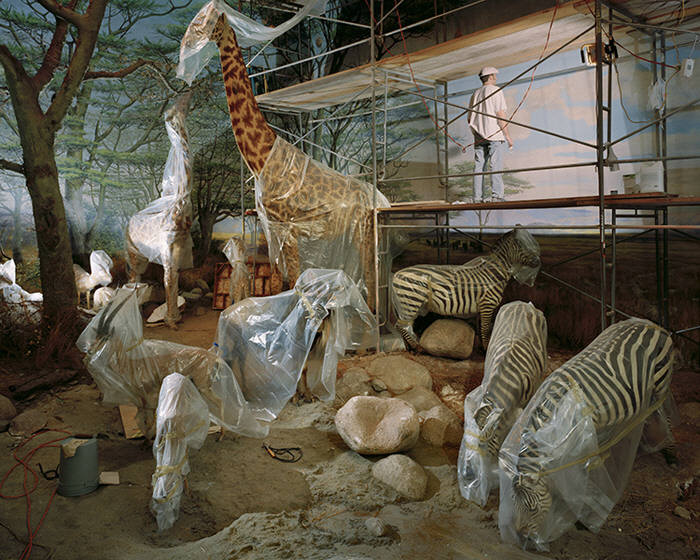
    Have you ever wanted to know what is happening in the rooms marked Closed for visitors in the museums? Internationally known, award winning artist Richard Barnes spent ten years in those rooms, and through his lens we can see that there is actually nothing natural in a natural history museum.

    The restoration team’s effort to create reality is unrealistic. In order to capture the typical landscape they generalize it, creating a fake one. The sky is either too bright or too watery and seems already dusty the moment it is painted. A caretaker is vacuuming the snowy ground beneath the feet of a buffalo while other animals become surrealistic ghosts in their plastic wraps. The habitats are alienated from real life and preserved in order to illustrate nature, a contradiction that creates a “morte vita”, a dead life.

    Emese Krunák-Hajagos