By Matt Macintosh
Curated by Barbara Fischer
June 8 – August 20, 2011
Justina M. Barnicke Gallery (Hart House), University of Toronto
 Angel of Light
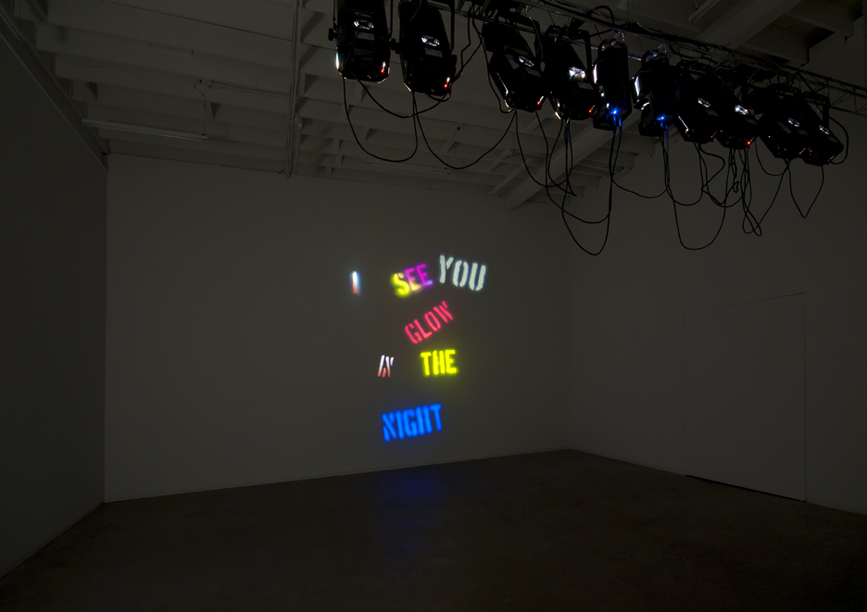
Angel of Light is the title of a song by seminal Christian rock band Petra. And if you turn right upon entering Kevin Schmidt’s exhibit, Don’t Stop Believing at Justina M. Barnike Gallery, it is also the title of the first work you’ll see. Schmidt has projected individual lyrics from the song which hazily takes aim at the simulated light generated by evil to lure good Christians away from God’s one true Light. Stage lights inscribed with the unlikely names, Intimidator and Intimidator 2 hold gobos which atomize Petra’s harangue into a discordant cycle of moralizing aphorisms whirring and squeaking their way onto the viewer and around the room. As pink, cyan, red, and yellow light is cast, a sort of critical calm is experienced, swapping gravitas with humour, charm and character. It’s a reflection on the kind of rock and roll hype machinery presumably used by Petra as a means to draw fans into their fold.
 Burning Bush
Burning Bush (2005) is a five-hour single channel video of a sage brush in the B.C. desert-interior trimmed with flapping paper simulated flame-lights. Tawdry treatments of religious discourse are low fruit, but Burning Bush’s stable, unflinching formal arrangement which yokes foreground to background reaps rewards here. Again, with knowingness Schmidt takes religious cliché and presents it in a jokey way to invert the sublime character of representations of sublime subject matter. A background desert mountain vista offering a nod to the Kantian sublime (something like fear/joy at the overwhelming enormity of Nature), and the foreground mythic-narrative of God speaking through an angel through a bush, are compositionally stacked one atop the other in a tension for command of our attention and link to a gaff in religious translation: did God speak to Moses through seneh, a bush; or Sinai, a mountain? Which all at first seems hokey and clever and funny, but then plays out in experience as an unapologetically artificial stimulator of open, contemplative and meaningful personal moments.
 Epic Journey
Subtle changes that occur in the natural backdrop add a temporal element both to Burning Bush and Epic Journey (2010), a single channel woEpic Journeyrk featuring a man drifting down B.C.’s Frasier river in a small trolling boat outfitted with a projector screen showing Peter Jackson’s entire eleven and a half hour Lord of the Rings film trilogy. In this case the temporal element is unjoined. In comparison to the relentlessly lulling real-time progression of the drifting boat, the movie moves around in dramatic edits of time and space and, in spite of its epic length, progresses instantly as it traces its own story. Both stories are traced, of course; both have preordained paths. And both trace language, visual storytelling and audible storytelling-cum-commentary onto themselves and onto each other. Here Schmidt relaxes and tenses role-playing within a discourse of understanding between sense-maker and object of inquiry; map and terrain; between the interaction of conceptualized experience and experience-as-actually-lived as it unfolds spontaneously. A formal and conceptual tension is anchored by a wonderfully placed light aboard the boat. Echoing lights on the shoreline, it draws ground into figure and works as a marker—an artificial, fixed point of reference to aid orientation (counter-pointing the stars in navigation to God in the spiritual realm). Finding one’s place is constituent to a work which is almost certainly understood as having no beginning or end. One inevitably arrives and leaves somewhere in the middle, personal responses having been shaped by the interaction of the two major plot elements in the video. They beg the question, “Just how ‘epic’ is something half-done?” This seems to frame the work within the hyperbole of the leisure activity of boating and slacker culture movies, somewhere between the pathos-saturated metal ballads of bands such as Petra, quest-driven 16-bit video games, and Bill and Ted’s Excellent Adventure – all which continue to resurface and reinvigorate culture in varying degrees.
 A Sign in the Northwest Passage
A Sign in the Northwest Passage is the most directly political and interventionist work. Although it instrumentalizes certain recurring concerns and practices including a witty sort of rustic and theatric self-effacement, it seemed the odd man out among curator Barbara Fischer’s otherwise very coherent show. The artist went to some lengths to install a routed sign made of cedar boards in a remote spot in Canada’s far north that will float off after the summer ice-melt. The sign looked Photoshopped in the images, though we have enough clues to assume it’s not. Using the book of Revelation (yawn) to provide commentary for capitalist imperialism enabled by climate change, the work takes on certain practical, material and aesthetic features of the Klondike era gold-rush, and goes for the old, “looking back to imaginings about the future from the perspective of the now” in order to try to overlay something vaguely ominous (or jokey ominous) about the now, much like Petra’s own strategies. The accompanying artists book, Journey (also the name of the group behind 1981’s, Don’t Stop Believing) is about the process: travel, construction, seeing the work unassembled, assembled, installed, and so on. So too, are a pair of traced or projected watercolours which I thought fell particularly flat. In spite of serving in part as documentation of the artist’s own experience, they didn’t escape looking like patronizing, incomplete Tim Gardeners: dauby realist faux naïve ‘genre’ pictures of the leisure pursuits of working-class provincial-types.
Schmidt wryly and deftly pairs religious and pop-cultural cliché to purge a tendency toward the reification of either. In Shmidt’s whirring bouncy meandering through à la carte Christianity, doctrinal sentimentality takes on a charm in its own right as an obsolete provider of “special” effects. This sort of knowing rock-tinged simulated stimulation makes for some lovely moments: quiet contemplation precipitated and guided by external phenomena so self-undermining that it’s nearly impossible to fall into idolatry. What I found particularly admirable is Schmidt’s ability to effect a transformation in attention toward the mundane. What, thankfully, is not purged is, as the exhibition’s title may suggest, an invitation toward attentive light-heartedness—something equally worth bringing to the church or the arena.