Author: artoronto

  • Kevin Schmidt : “Don’t Stop Believing”

    By Matt Macintosh

    Curated by Barbara Fischer
    June 8 – August 20, 2011
    Justina M. Barnicke Gallery (Hart House), University of Toronto
    Angel of Light
     

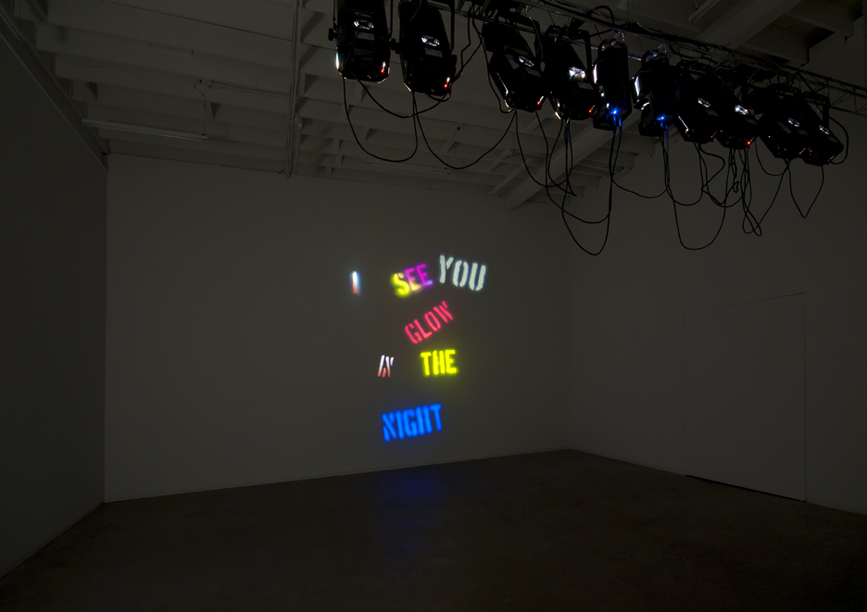
     Angel of Light  is the title of a song by seminal Christian rock band Petra. And if you turn right upon entering Kevin Schmidt’s exhibit, Don’t Stop Believing at Justina M. Barnike Gallery, it is also the title of the first work you’ll see. Schmidt has projected individual lyrics from the song which hazily takes aim at the simulated light generated by evil to lure good Christians away from God’s one true Light. Stage lights inscribed with the unlikely names, Intimidator and Intimidator 2 hold gobos which atomize Petra’s harangue into a discordant cycle of moralizing aphorisms whirring and squeaking their way onto the viewer and around the room. As pink, cyan, red, and yellow light is cast, a sort of critical calm is experienced, swapping gravitas with humour, charm and character. It’s a reflection on the kind of rock and roll hype machinery presumably used by Petra as a means to draw fans into their fold.

    Burning Bush

     Burning Bush (2005) is a five-hour single channel video of a sage brush in the B.C. desert-interior trimmed with flapping paper simulated flame-lights. Tawdry treatments of religious discourse are low fruit, but Burning Bush’s stable, unflinching formal arrangement which yokes foreground to background reaps rewards here. Again, with knowingness Schmidt takes religious cliché and presents it in a jokey way to invert the sublime character of representations of sublime subject matter. A background desert mountain vista offering a nod to the Kantian sublime (something like fear/joy at the overwhelming enormity of Nature), and the foreground mythic-narrative of God speaking through an angel through a bush, are compositionally stacked one atop the other in a tension for command of our attention and link to a gaff in religious translation: did God speak to Moses through seneh, a bush; or Sinai, a mountain? Which all at first seems hokey and clever and funny, but then plays out in experience as an unapologetically artificial stimulator of open, contemplative and meaningful personal moments.

    Epic Journey

     Subtle changes that occur in the natural backdrop add a temporal element both to Burning Bush and Epic Journey (2010), a single channel woEpic Journeyrk featuring a man drifting down B.C.’s Frasier river in a small trolling boat outfitted with a projector screen showing Peter Jackson’s entire eleven and a half hour  Lord of the Rings film trilogy. In this case the temporal element is unjoined. In comparison to the relentlessly lulling real-time progression of the drifting boat, the movie moves around in dramatic edits of time and space and, in spite of its epic length, progresses instantly as it traces its own story. Both stories are traced, of course; both have preordained paths. And both trace language, visual storytelling and audible storytelling-cum-commentary onto themselves and onto each other. Here Schmidt relaxes and tenses role-playing within a discourse of understanding between sense-maker and object of inquiry; map and terrain;  between the interaction of conceptualized experience and experience-as-actually-lived as it unfolds spontaneously. A formal and conceptual tension is anchored by a wonderfully placed light aboard the boat. Echoing lights on the shoreline, it draws ground into figure and works as a marker—an artificial, fixed point of reference to aid orientation (counter-pointing the stars in navigation to God in the spiritual realm). Finding one’s place is constituent to a work which is almost certainly understood as having no beginning or end. One inevitably arrives and leaves somewhere in the middle, personal responses having been shaped by the interaction of the two major plot elements in the video. They beg the question,  “Just how ‘epic’ is something half-done?” This seems to frame the work within the hyperbole of the leisure activity of boating and slacker culture movies, somewhere between the pathos-saturated metal ballads of bands such as Petra, quest-driven 16-bit video games, and Bill and Ted’s Excellent Adventure – all which  continue to resurface and reinvigorate culture in varying degrees.

    A Sign in the Northwest Passage

     A Sign in the Northwest Passage is the most directly political and interventionist work. Although it instrumentalizes certain recurring concerns and practices including a witty sort of rustic and theatric self-effacement, it seemed the odd man out among curator Barbara Fischer’s otherwise very coherent show. The artist went to some lengths to install a routed sign made of cedar boards in a remote spot in Canada’s far north that will float off after the summer ice-melt. The sign looked Photoshopped in the images, though we have enough clues to assume it’s not. Using the book of Revelation (yawn) to provide commentary for capitalist imperialism enabled by climate change, the work takes on certain practical, material and aesthetic features of the Klondike era gold-rush, and goes for the old, “looking back to imaginings about the future from the perspective of the now” in order to try to overlay something vaguely ominous (or jokey ominous) about the now, much like Petra’s own strategies. The accompanying artists book, Journey (also the name of the group behind 1981’s, Don’t Stop Believing) is about the process: travel, construction, seeing the work unassembled, assembled, installed, and so on. So too, are a pair of traced or projected watercolours which I thought fell particularly flat. In spite of serving in part as documentation of the artist’s own experience, they didn’t escape looking like patronizing, incomplete Tim Gardeners: dauby realist faux naïve ‘genre’ pictures of the leisure pursuits of working-class provincial-types.

    Schmidt wryly and deftly pairs religious and pop-cultural cliché to purge a tendency toward the reification of either. In Shmidt’s whirring bouncy meandering through à la carte Christianity, doctrinal sentimentality takes on a charm in its own right as an obsolete provider of “special” effects. This sort of knowing rock-tinged simulated stimulation makes for some lovely moments: quiet contemplation precipitated and guided by external phenomena so self-undermining that it’s nearly impossible to fall into idolatry. What I found particularly admirable is Schmidt’s ability to effect a transformation in attention toward the mundane. What, thankfully, is not purged is, as the exhibition’s title may suggest, an invitation toward attentive light-heartedness—something equally worth bringing to the church or the arena.

  • Easy Tiger

    August 3 – 27, 2011
    Opening: Wednesday, August 3, 7pm-11pm
    Steam Whistle Gallery
    255 Bremner Ave
    (just south of the CN Tower)
    Toronto, ON
    416-362-2337 ext.246
    info@steamwhistle.ca
    www.steamwhistle.ca
    Hours: Mon – Thurs 12 – 6, Fri – Sat 11 -6, Sun 11 – 5pm

    Come by and see music and art collide for our August art exhibit.
     

    Easy Tiger is a Toronto based arts collective committed to promoting quality art and music without limitations or prejudice across all genres and mediums. Friends who are drawing from varied experience and skill, the group is equipped to lend our dirty hands to the success of projects small and large. Dean Povinsky, Brad Leitch and Ben Sellick are combining the two worlds with live music performances and an art exhibit on August 3rd 7-11pm.


     Steam Whistle Brewing hosts monthly art exhibitions in their Retail & Hospitality area to showcase local creative talent. Although many exhibitors are established artists, some are showing for the first time. Steam Whistle does not charge rent for their gallery space, nor is a commission earned on any works that are sold. At the close of each show, one piece from the show (of the artist’s choice) is donated to their permanent collection bringing further profile to artists through the thousands of visitors to the brewery annually.

  • Istvan Kantor Brainwash Session 2 @ The Temple of Desperadoes

    August 13, Saturday 2 – 6 pm
    ANTIX – Centre for Art Crime and Neoism
    276 Crawford Street, Toronto
    through drive way towards garage
    www.istvankantor.com
    http://home.interlog.com/~amen/
    http://www.hungarianpresence.ca/Culture/Media/kantor-215.cfm

    ANTIX ArtCrime Depot is Istvan Kantor’s storage space and summer gallery, archive of Kantor’s life and crimes, a meeting place for secret conversations, future projects, conspiracy plans, also amazing deals on bloody canvases and many other beautiful Neoist Monty Cantsin artifacts! Come with a juice or beer, bring your friends, look around, sit down, have a great afternoon… while the Rentagon is out on vacation, we R right into revolution!

    Istvan Kantor’s artistic practice incorporates robotic sculpture, video, performance, mixed-media installation, painting, sound, and various other action-based social-mediums like the open-pop-star movement of Monty Cantsin and the world wide network of Neoism. Neoism is a transmission interface and revolving platform to gain public support and media attention for its users.
    Kantor employs all his skills and talents to constantly surprise and fascinate. “I swear to God, I’ll never make any boring art!” he declares with bold determination, irony and wit, holding up a picketing sign.
    His main interest lies in creating work that establishes a discussion within and around the conflicting territories of institutional authority and cultural gentrification. In this regard Kantor’s work investigates the revolutionary and scientific aspects of artistic practices that attempt to surpass the conventional models of creative experience.
    Istvan Kantor is Hungarian-born, Toronto-based artist. Recent and upcoming solo exhibitions include: Monty Cantsin Was Here, Jogja National Museum, Yogyakarta, Indonesia, febr/2011; Made in Estonia, installation, Tallinn, may/2011; Selected works, St.Istvan Museum, Szekesfehervar, Hungary, oct/nov 2011 Upcoming group exhibitions include: Interakcje Festival, Piotrkow, Poland, may/2011; WRO Biennale, Wroclaw, Poland, may/2011

    Istvan Kantor aka Monty Cantsin is also known as a noise/music artist, electro-instrumentalist and singer of the Toronto based Red Armband. He has recorded and released over a dozen albums of songs and noise works since the early 80s.

  • Picasso: Masterpieces from the Musée National Picasso, Paris

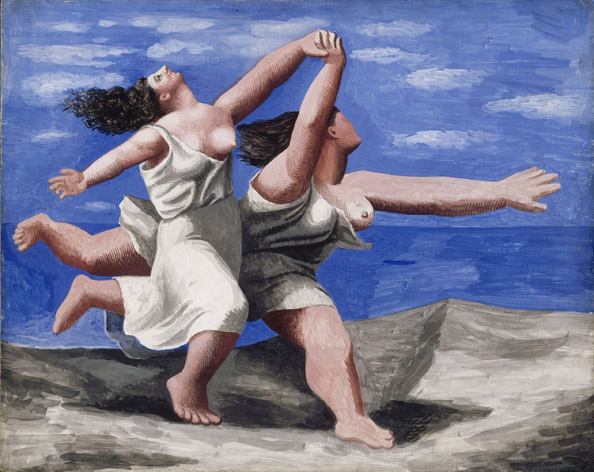
    Deux femmes courant sur la plage (La Course) (Two Women Running on the Beach [The Race]), 1922 ,Gouache on plywood, 32.5 x 41.1 cm. Pablo Picasso gift-in-lieu, 1979, MP78 Musée National Picasso, Paris(C) Succession Picasso, 2011 (C) RMN / Jean-Gilles Berizzi

    In 2012, the Art Gallery of Ontario (AGO) presents a major survey of masterworks by the most inventive and influential artist of the 20th century, Pablo Picasso. Picasso: Masterpieces from the Musée National Picasso, Paris features more than 150 highlights from the Musée’s unparalleled collection, including paintings, sculptures, prints and drawings. The exhibition will be on view at the AGO for just 17 weeks, from April 28 through August 26, 2012.

    The collection of the Musée National Picasso, Paris comprises more than 5,000 works that Picasso kept for himself and his family over the course of his career, ranging from informal sketchbooks to iconic masterpieces. Picasso: Masterpieces from the Musée National Picasso, Paris features is touring the world while the Musée undergoes a multi-year renovation, scheduled for completion in 2012.

    “Presenting Picasso masterpieces to Canadian audiences is a major accolade for our country and the Province of Ontario,” said President of the AGO Board of Trustees Tony Gagliano.  “The AGO is most proud to host these artworks and honoured to provide the opportunity to experience one of the art world’s greatest masters.”

    The AGO is the sole Canadian and final venue on the tour, which includes stops in Madrid, Abu Dhabi, Tokyo, Helsinki, Moscow and St. Petersburg, Seattle, Richmond, San Francisco and Sydney.

    “This is an extraordinary opportunity for Canadian audiences to view major works by Picasso, drawn from the world’s most comprehensive collection of his artwork,” says Matthew Teitelbaum, the AGO’s Michael and Sonja Koerner Director, and CEO. “With Abstract Expressionist New York, this fall’s Chagall and the Russian Avant-Garde, and now Picasso, AGO members and visitors have the chance to take an incredible, year-long journey through some of the most thrilling and significant moments and masterpieces of 20th-century art.”

    Exhibited chronologically and covering virtually every phase of the modern master’s unceasingly radical and diverse career, Picasso: Masterpieces from the Musée National Picasso, Paris features:

    • The Death of Casagemas, one of the first works he created in Paris in 1901;
    • Autoportrait (Self-Portrait), the iconic 1906 self-portrait;
    • the 1904 Blue-period masterpiece Celestina (The Woman with One-Eye), and The Two Brothers, a 1906 work from his Rose period;
    • landmark African-inspired artwork that led to the advent of Cubism, including studies for the 1907 masterpiece Les Demoiselles d’Avignon and Three Figures Beneath a Tree, 1907-08;
    • examples of his genre-defining Analytic and Synthetic Cubism artworks, including the 1909-10 Sacré Coeur, 1911’s seminal Man with a Guitar and 1915’s Violin;
    • Two Women Running on the Beach (The Race), a 1922 masterwork from his Neoclassical period, and 1925’s The Kiss, from his Surrealist period;
    • a series of sculptures created during the Second World War, including 1942’s Bull’s Head, and two bronzes, 1943’s Death’s Head and 1950’s The Goat;
    • The Bathers, the 1956 life-sized, six-piece figurative sculpture series created during a summer in Cannes; and
    • The Matador, the famous self-portrait painted in 1970, three years before his death.

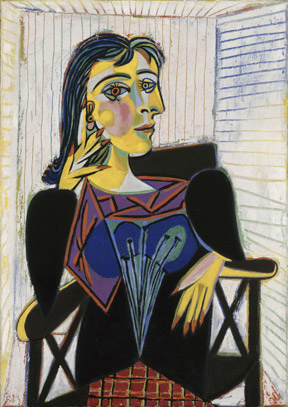
    The exhibition also highlights Picasso’s depictions of his numerous muses and mistresses, including 1918’s Portrait of Olga in an Armchair, which features the Russian ballerina and Picasso’s first wife seated on a Spanish tapestry, the background left purposefully unfinished. French surrealist photographer Dora Maar, who inspired his 1937 “Weeping Woman” series, is also prominently featured, as is Jacqueline Roque, Picasso’s second wife and most-painted muse, depicted in the 1954 work Jacqueline with Crossed Hands.

    Portrait of Dora Maar, 1937, oil on canvas, 92 x 65 cm, Musée National Picasso, Paris. Pablo Picasso gift-in-lieu, 1979, MP158 (C) Succession Picasso, 2011 (C) RMN / Jean-Gilles Berizzi

    “A dialogue about Picasso and his extraordinary career started at the AGO with the ground- breaking exhibition Picasso and Man in 1964,” says Anne Baldassari, chairman and chief curator of collections of the Musée National Picasso, Paris. “Now, the conversation continues with Picasso: Masterpieces from the Musée National Picasso, Paris, an exhibition presenting a magnificent collection of the artist’s work, giving Toronto audiences a true understanding of the artist’s inventive and transformative legacy.”

    AGO members will be invited to an exclusive advance preview of Picasso: Masterpieces from the Musée National Picasso, Paris in the days leading up to the exhibition’s public opening. As with Abstract Expressionist New York: Masterpieces from The Museum of Modern Art and Chagall and the Russian Avant-Garde: Masterpieces from the Centre Pompidou, Paris, AGO Members receive free admission and VIP access to the exhibition, among other discounts and benefits. A 296-page catalogue has been published to accompany the exhibition. Edited by Anne Baldassari, Picasso: Masterpieces from the Musée National Picasso, Paris includes 194 illustrations and will be available for purchase at shopAGO.

    Picasso: Masterpieces from the Musée National Picasso, Paris is curated by Anne Baldassari, chairman and chief curator of collections of the Musée National Picasso, Paris. Elizabeth Smith, the AGO’s executive director of curatorial affairs, will oversee the exhibition’s installation at the AGO. The exhibition is co-organized by the Musée National Picasso, Paris and the Art Gallery of Ontario.

  • Haute Culture: General Idea — A Retrospective, 1969 – 1994

    Baby Maker 3, 1984-1989, cromogenic print, 76.2 x 63.5 cm. Collection Fonds national d’art contemporain, France. Image courtesy the Estate of General Idea and the Art Gallery of Ontario.
      
     
    July 30, 2011 – January 1, 2012.
    panel discussion: Jackman Hall
    Wednesday, November 16 
    ART GALLERY OF ONTARIO
    317 Dundas Street West,
    Toronto, ON M5T 1G4
    T:416-979-6648
    www.ago.net
    Hours: Tue & Thurs – Sun 10 – 5:30, Wed 10 – 8:30
     
    “This is the story of General Idea and the story of what we wanted. We wanted to be famous, glamorous, and rich. That is to say, we wanted to be artists and we knew that if we were famous and glamorous we could say we were artists and we would be.”
    General Idea, excerpt from “Glamour,” FILE Magazine, vol. 3, no. 1, fall 1975. 

    The exhibition features 336 works by the groundbreaking multidisciplinary group, including 107 works from the AGO collection, spanning their prolific and influential 25-year career.  
    Curated by Paris-based independent curator Frédéric Bonnet, Haute Culture is the first comprehensive retrospective devoted to General Idea, a collaboration between artists AA Bronson, Felix Partz and Jorge Zontal that began Toronto in 1969. The group’s transgressive concepts and provocative imagery challenged social power structures and traditional modes of artistic creation in ever-shifting ways, until Partz and Zontal’s untimely deaths from AIDS-related causes in 1994.  
    “General Idea is a truly seminal Canadian artist group whose diverse and increasingly influential production warrants deep and comprehensive consideration,” says Matthew Teitelbaum, the AGO’s Michael and Sonja Koerner Director, and CEO. “We are so pleased to mount an exhibition of their work on this large a scale, as I know that our visitors will find their exuberant and exacting vision to be intensely rewarding.” 
    Haute Culture is organized around five themes central to the trio’s production: “the artist, glamour and the creative process”; “mass culture”; “architects/archaeologists”; “sex and reality”; and “AIDS.” In addition to the works on view inside the exhibition, the AGO will install the artists’ two-metre-tall AIDS sculpture at the corner of Dundas West and Beverley streets.  The lacquered metal sculpture, created in 1989, is based on Robert Indiana’s 1970 LOVE sculpture and will be on view throughout the exhibition’s run.
    “Through a prolific creation, General Idea’s body of work reveals a complex combination of reality and fiction, and of parody and rigorous cultural critique,” says Bonnet. “Treating the image as a virus that infiltrates every aspect of the real world, the group set out to colonize it, modify it and so present an alternate version of reality. Their visionary influence has only become more apparent with the passage of time.” 
    Haute Culture was first exhibited at the Musée d’Art moderne de la Ville de Paris, from February 11 to May 29, 2011. The AGO’s presentation of the exhibition is curated by David Moos, the Gallery’s former curator of modern and contemporary art, and Georgiana Uhlyarik, the AGO’s assistant curator of Canadian art.  
    A 224-page hardcover catalogue has been published to coincide with the exhibition. Edited by Bonnet, General Idea features more than 200 colour and black-and-white reproductions and includes contributions from Bonnet, Bronson and Moos, among others. Published by JRP|Ringier and distributed by Distributed Art Publishers, the publication is available at shopAGO for $44. 
     
    Haute Culture: General Idea — A Retrospective, 1969 – 1994 is conceived and organized by the Art Gallery of Ontario in conjunction with the Musée d’Art moderne de la Ville de Paris. The exhibition is generously supported by the Volunteers of the Art Gallery of Ontario, Thomas H. Bjarnason & Woodrow A. Wells and Paul E. Bain & Isa Spalding. Contemporary programming at the AGO is supported by the Canada Council for the Arts.  

    Contemporary programming at the AGO is supported by the Canada Council for the Arts

  • The Square Foot Exhibit


    August 5 – 21, 2011
    TWIST GALLERY
    Preview Gala: Friday, August 5, Tickets: $20
    Public reception. Saturday, August 6.Free, line ups are expected
    1100 Queen St. West
    Toronto, ON  M6J 1H9
    T: 416 – 588 – 2222
    www.twistgallery.ca
    Hours: Wed-Fri 12 – 7pm,  Sat – Sun 12 – 5pm

    Detail from Phil Anderson’s interview with artist/organizer  Nurit Basin:
    The show grew in size, one year I believe it was in 2008 we had over 900 artists and over 2000 pieces of artwork. I think the biggest challenge was communicating with so many artists regarding deadlines of dropping off the artwork, making sure all the artwork is accounted for during the show, and the pick-up of the artwork. At the end of each show we learn new things on how to improve the logistics and apply them to the following year.
    Anderson: What do think is the attraction for the public to go to Square Foot?
    Basin: A couple of things such as the number of artists that take part in the show and the number and variety of works that are exhibited in one room. Once all the artwork in hung it actually starts to look like one big art piece which is the installation itself.
    To read the whole interview please check out our News section
  • JUN KANEKO

    June 30 – September 18, 2011
    GARDINER MUSEUM
    111 Queen’s Park
    Toronto, On M5S 2C7
    Tel:1 416.586.8080
    mail@gardinermuseum.com
    Hours: Mon-Tues 10-6, Fri 10-9, Sat-Sun 10-5pm

    Jun Kaneko (American, born Japan 1942) studied painting in his native Japan as a young man. In 1963, he moved to the United States where he studied ceramics with a number of influential artists from the California School, including Peter Voulkos and Paul Soldner. Although Kaneko is best known for creating large-scale ceramic sculptures and installations, painting has remained an important part of his artistic practice throughout his career. In recent years Kaneko has also branched out to design opera sets and costumes for several productions in Omaha, Atlanta, Philadelphia and Vancouver.

    This exhibition presents a survey of 39 works by Kaneko ranging in date from the early 1980s to the early 2000s. The works in the exhibition include a mix of large and small ceramic sculptures as well as a selection of paintings and drawings. The combination of works in different media emphasizes Kaneko’s strong command of form and colour, and his longstanding interest in optics and perception.

    Jun Kaneko is a traveling exhibition organized by Smith Kramer Fine Art Services for a tour of North America. The Gardiner Museum is the final stop on the tour and the only scheduled Canadian venue for the exhibition.

  • Don’t Stop Believing by Kevin Schmidt

    Kevin Schmidt, Epic Journey, 2010. Single channel HD video with stereo sound, 11hr 30min. Courtesy of Catriona Jeffries Gallery, Vancouver

    June 8 – August 20, 2011
    Justina M Barnicke Gallery
    (Hart House), University of Toronto
    7 Hart House Circle.

    Toronto, Ontario M5S 3H3
    T: 416-978-8398
    Hours: Mon-Wed & Fri 11-5,Thur 11-7,Sat-Sun 1-5 pm

    Curated by Barbara Fischer

    Including several recent conceptual and cinematic installations, the exhibition offers a concise introduction to Schmidt’s ongoing interests. In particular, the exhibition brings together works that share the tropes of the solitary epic quest as narrated in popular science fiction, spiritual discovery, scientific expedition, and music.

    Kevin Schmidt first came to international attention with his single-channel 2002 video work “Long Beach Led Zep” featuring the artist’s studied solo guitar performance of Led Zeppelin’s “Stairway to Heaven” staged against the setting sun of Vancouver Island’s mythic Long Beach. Since then, the combination of sublime settings and heroic, DIY or amateur quests have been a recurrent element in his installations, such as in the works in this exhibition. Taking their point of departure in a wide array of generation-defining cultural referents and re-enactments – Tolkien’s famed trilogy “Lord of the Rings”, the song” Angel of Light” by the Rock group Petra, as well as expeditions such as Franklin’s failed search for the Northwest Passage, among others – Schmidt’s interests in the epic quest expresses the desire to go beyond the limits of knowledge and to chart the more ethereal territories of other non-rational worlds.

    If the expression of this desire often finds form in manufactured spectacle or sublime nature, Kevin Schmidt’s appropriations and enactments of these are tempered by skepticism. His work counters the traps of blind acceptance using the visible reminders of handy-man construction and theatrical devices – smoke machines, generators, stage lights and even a DIY video projector – all the while seeking to produce experiences that exceed common cause or practical reason. Adapting the title of the American rock band Journey’s 1981 hit single, “Don’t stop believin’ ” for the exhibition, Schmidt’s interest in the classic, modern tension between doubt and faith appears as a constant balancing act in his works. Particularly, the artist’s work suggests that this productive pulse inheres in the very purpose and possibility of art as it constantly reconsiders conviction while critically reflecting on the apocalyptic proclamations of religion, the manufactured seductions of spectacle, or the romance of scientific expeditions’ search for the truth.

    The exhibitions and programs of the Justina M. Barnicke Gallery are generously supported by the Canada Council for the Arts. The Gallery is wheelchair accessible.

  • Libby Hague: Sympathetic Connections

    June 11 –  September 11, 2011
    ART GALLERY OF ONTARIO
    317 Dundas Street West,
    Toronto, ON M5T 1G4
    T:416-979-6648
    www.ago.net
    Hours: Tue & Thurs – Sun 10 – 5:30, Wed 10 – 8:30

    Toronto-based artist Libby Hague’s new installation at the Art Gallery of Ontario (AGO) extends beyond gallery walls and onto the AGO’s Dundas Street façade. Libby Hague: Sympathetic Connections,  is part of the AGO’s Toronto Now series of rotating contemporary projects by Toronto artists. The installation transforms woodblock prints into paper sculptures that connect across the walls, ceiling, and external windows of the AGO’s Young Gallery. 

    Sympathetic Connections combines representational and abstract forms in a room-spanning three-dimensional installation. Colourful sculptural forms crafted from Japanese paper fill the gallery, dangling from walls and cascading down from the ceiling, while a wall-mounted print of a nuclear power plant looms in the periphery, an image inspired in part by the Fukushima Daiichi nuclear disaster in Japan earlier this year.  

    “Libby Hague’s playful, yet foreboding narratives give physical form to fictional worlds that simultaneously mirror and manipulate reality,” says Michelle Jacques, the AGO’s acting curator of Canadian art. “Sympathetic Connections provides a timely exploration of our problematic relationship with the natural environment, invoking universal themes of responsibility and dependency, vulnerability and rescue, and risk and luck.” 

    Toronto Now is generously supported by The Contemporary Circle. Contemporary programming at the AGO is supported by the Canada Council for the Arts.

  • Evidence by Lynn Harrigan

    embroidery and printing with silk, cotton, wool
     
    July 31 – September 2, 2011
    Roadside Attractions
    911 Davenport Road,
    Toronto, ON  M6G 2B7
    Daily 8 a.m. until 1 a.m.
     

    Many Creationists have a powerful need to cleave to a literal reading of the Bible. They have concluded that, since the universe was purportedly created in a single week, fossil evidence of the evolution of life is actually an elaborate trick designed by God to test their faith. Scientific proof of a past before recorded history is trumped by their longing for a future beyond death. Their creative interpretation of the world has evolved from a need for certainty expounded by literal interpretations of the Word. Fascinated with the strange and beautiful variations of evidence that have survived over millions of years, the artist also takes liberties with truth, colouring her perceptions to assuage her own desires.

    Evidence presents a series of three-dimensional trilobite fossils suspended in time and space. Each trilobite is hand-embroidered on eco-printed silk and wool which is then sewn into the shape of rocks.  Just as imagination requires the suspension of disbelief, faith in the beauty of truth is embodied by this suspended Evidence.

    Lynn Harrigan is a Toronto-based fibre artist and teacher. Artist’s website: lynnharrigan.com